After Last Call: Inside the Breweries That Come Alive When Everyone Else Goes to Sleep
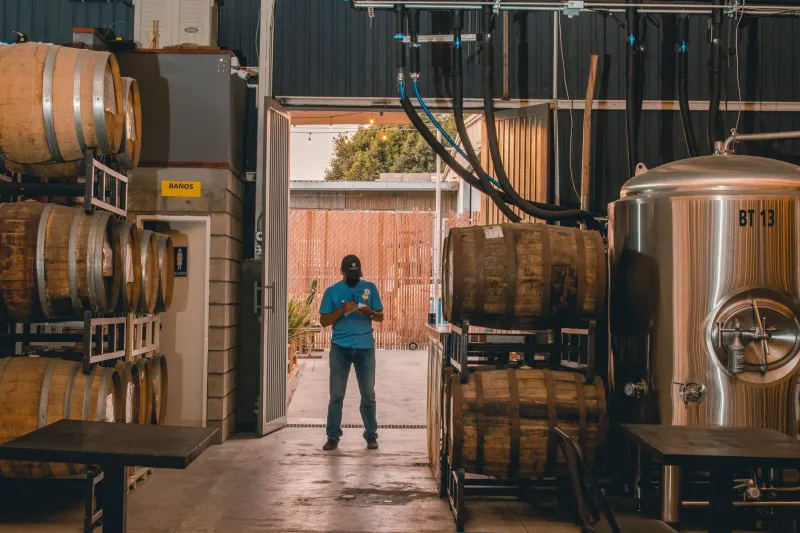
It's 1:47 in the morning in East Nashville, and Theo Brandt is elbow-deep in a grain mash that smells like toasted caramel and something faintly floral he can't quite name yet. The rest of the building — a converted auto-parts warehouse with exposed brick and a ceiling fan that wobbles like it's been arguing with itself for years — is quiet except for the hiss of steam and the low hum of a playlist he's been building since 2019.
"I've been a night person my whole life," he says, not looking up from the mash tun. "I tried doing this during the day for about six months. It felt wrong. Like wearing someone else's shoes."
Brandt's brewery, which operates exclusively between the hours of 10 p.m. and 6 a.m., is part of a small but growing movement of off-hours operations that are quietly reshaping what a brewery can look like — and who it can serve.
The Logic of the Night Shift
For most of beer's modern American history, the craft brewery has followed a pretty predictable schedule. Brew in the morning, open the taproom in the afternoon, close by ten. It's a model built around zoning laws, liquor licenses, and the assumption that beer drinkers keep daytime hours.
But that assumption has always had a blind spot.
Hospitality workers, nurses, warehouse employees, rideshare drivers — a huge portion of the American workforce operates outside the standard nine-to-five. For these workers, the traditional taproom schedule is essentially inaccessible. By the time they're off the clock and looking for a cold beer in a comfortable space, the lights are already off.
"I worked restaurant service for twelve years before I started brewing," says Keisha Drummond, who runs a small taproom in Pittsburgh that opens at 6 a.m. and closes at 2 p.m. "I know exactly what it feels like to want somewhere to go when the rest of the world is just waking up. That's who I built this place for."
Drummond's morning-only taproom — which she opened in 2022 in a former diner space — serves a rotating selection of lighter ales, session lagers, and a rotating cold brew collaboration with a local coffee roaster. On any given weekday morning, her regulars include ER nurses finishing overnight shifts, city bus drivers on their first break, and a rotating cast of construction workers who've been on-site since five.
"Nobody's getting hammered," she says. "They're having one or two beers and unwinding. The same thing everyone else does at five in the evening. They just do it at nine in the morning."
Noise, Neighbors, and the 2 A.M. Mash
Brewing at night comes with a particular set of logistical headaches that daytime operations never have to think about. Chief among them: sound.
Grain mills are loud. Pumps are loud. The rhythmic clanking of a brew-in-progress carries differently at 2 a.m. than it does at 2 p.m., and not everyone within earshot is happy about it.
"We've had noise complaints," Brandt admits, with the weary tone of someone who has memorized the city's sound ordinance by necessity. "We've done a lot of acoustic insulation work. We've changed our milling schedule. It's an ongoing negotiation with the neighborhood."
That negotiation isn't always adversarial, though. Some breweries operating unconventional hours have found that being transparent with their neighbors — showing up to community meetings, explaining their process, even inviting nearby residents in for a tour — transforms potential opponents into advocates.
In Portland, Oregon, a small fermentation lab that brews exclusively between midnight and dawn has built what its founder calls a "night neighborhood" — a loose community of other late-night workers and insomniacs who've started treating the brewery's loading dock as an informal gathering spot.
"We put out a couple of folding chairs and a cooler one night just to be hospitable," the founder says. "Now there are eight regulars who show up around 2 a.m. just to hang out while we work. It's become its own thing."
Fermentation Likes the Dark
There's also a practical argument for night brewing that has nothing to do with community and everything to do with chemistry.
Temperature stability is critical during fermentation, and nighttime ambient temperatures — particularly in warmer climates — can be significantly easier to manage than the heat of a summer afternoon. Several brewers who've shifted to overnight operations cite reduced cooling costs and more consistent fermentation profiles as tangible benefits.
"My lagers have been better since I switched to night brewing," says a brewer in Austin, Texas, who converted to overnight operations partly out of necessity and partly out of curiosity. "I don't know if it's the temperature or the fact that I'm just more focused at night, but something changed."
It's the kind of anecdotal observation that's hard to quantify but impossible to dismiss — especially when the beer in the glass makes a compelling case.
Who Gets to Have a Third Place?
Underneath all the logistics and the fermentation science, the off-hours brewery movement is asking a quieter question: who gets access to the social rituals that a good taproom provides?
The craft beer world has spent the last decade working — with varying degrees of success — to become more inclusive. Off-hours operations represent a different kind of inclusion: one based not on identity but on schedule.
Keisha Drummond puts it plainly: "A third place — somewhere that's not work and not home, where you can just be a person for a little while — that shouldn't only be available to people who work nine to five. Everybody deserves that."
Her morning taproom doesn't have a sign out front. It doesn't need one. Her regulars found her through word of mouth, through a mention in a local Facebook group for healthcare workers, through someone telling someone else that there was finally a place for people like them.
That's not a marketing strategy. That's a community.