Dirt, Dew, and Dandelions: How Brewers Are Bottling the Taste of Where They Live
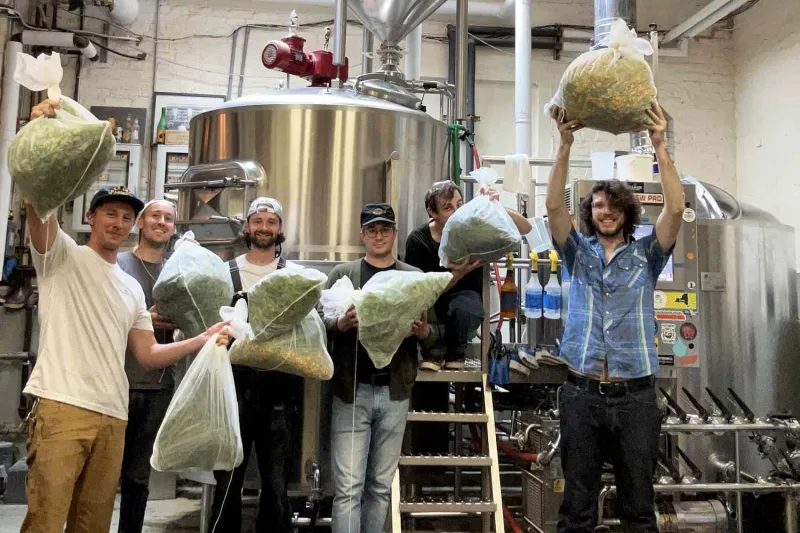
Photo: brewer foraging wild herbs botanicals forest craft beer ingredients, via www.foodandwine.com
There's a saison brewed in Vermont that tastes faintly of pine resin and rain-soaked bark. A wheat ale out of coastal Oregon carries a subtle brininess that you'd swear came from the Pacific itself. And a farmhouse ale from the Texas Hill Country somehow manages to evoke dry cedar and wild sage in a way that no hop variety ever could.
None of this is accidental.
Across the country, a growing wave of brewers is going well off the beaten path — literally — to source the raw materials that define their beers. We're talking foraged botanicals, wild-captured yeast strains, and heirloom grains grown within a day's drive of the brew kettle. The result is a category of beer that's less about style guidelines and more about place. These are beers that couldn't exist anywhere else.
Beyond the Ingredient Catalog
For most of commercial brewing history, the supply chain was relatively tidy. You called your hop broker, ordered your malt, and got to work. Even the craft beer revolution — for all its creativity — largely played within those same ingredient boundaries. The innovation was in the ratios, the processes, the barrel programs.
But something shifted in the last several years. Brewers started asking a different question: What if the ingredient itself is the story?
"I got tired of making beers that could theoretically be made anywhere," says one Pacific Northwest brewmaster who began harvesting spruce tips and wild yarrow from land near his facility. "I wanted someone to take a sip and have no doubt about where they were standing when this thing was made."
That impulse — call it hyperlocalism, call it terroir-driven brewing — is now driving some of the most interesting liquid in the country. And it's pushing brewers into roles they never expected: forager, farmer, amateur mycologist.
The Wild Yeast Gamble
If foraged botanicals are the flavor layer, wild yeast is the soul of this movement — and the part that makes conventional brewers genuinely nervous.
Commercial yeast strains are predictable. They do what they're supposed to do, within a known range, batch after batch. Wild yeast is none of those things. Captured from the open air, from fruit skins, from the bark of local trees, wild strains bring complexity — and real risk. Off-flavors, stuck fermentations, and batches that simply don't work are part of the deal.
But when it clicks? The results are extraordinary.
Breweries in places like the Appalachian foothills and the Upper Midwest are now maintaining their own wild yeast libraries — living collections of local microorganisms that give their beers a biological signature as unique as a fingerprint. One brewer in North Carolina described the process as "learning to listen to what's already in the air around you." It takes patience, a high tolerance for uncertainty, and a willingness to dump batches that don't make the cut.
"The failures are just tuition," he said.
Heritage Grains and the Flavor They Carry
The grain conversation is getting equally interesting. Modern barley varieties were largely bred for yield, consistency, and ease of processing — not flavor. Heritage grains like emmer, einkorn, red fife wheat, and landrace barleys were sidelined by industrial agriculture decades ago. Now brewers are working with small regional farms to bring them back.
These older grains behave differently in the mash. They can be stubborn, inefficient, and unpredictable in ways that frustrate brewers trained on modern malts. But they carry flavor compounds that have been essentially absent from beer for generations — nuttier, earthier, more complex base notes that change the entire character of a brew.
A handful of maltsters around the country, particularly in the Northeast and the Mountain West, have started specifically catering to this demand. They're working directly with grain farmers to revive regional varieties and malt them to spec for small breweries that want something genuinely different in the foundation of their recipes.
The Replication Problem (Which Is Actually the Point)
Here's the thing that makes terroir-driven brewing both exciting and commercially tricky: you can't replicate it. That's by design, but it creates real challenges.
Wild yeast harvests vary. A foraged botanical that was abundant one season might be scarce the next. Heritage grain crops are weather-dependent in ways that commodity agriculture isn't. The very qualities that make these beers special — their rootedness in a specific place and moment — also make them hard to scale and impossible to standardize.
For breweries built around consistent flagship products, that's a dealbreaker. But for smaller operations that have embraced a limited-release model and an audience that actually likes the fact that this year's batch is different from last year's? It's a feature, not a bug.
"We're not trying to make the same beer twice," said one brewer in the Sierra Nevada foothills. "We're trying to make the most honest version of this place, right now. That's always going to change a little."
Finding These Beers
If you want to explore what terroir-driven brewing actually tastes like, the best strategy is to go local and go small. These beers rarely leave their home region — distribution would undercut the whole point. Look for taprooms that talk openly about their ingredient sourcing, breweries with relationships with specific farms, and any label that mentions wild fermentation or foraged additions.
Farmers markets are increasingly a tip-off. Brewers who care about local ingredients often show up to the same markets where their grain farmers and botanical foragers sell their goods. It's a tight-knit network, and people in it tend to know each other.
The offshoot of this movement — the part that's quietly reshaping how Americans think about what beer can be — is a renewed sense that where you are matters. That geography has flavor. That a beer made with intention and local knowledge is something worth seeking out, even if it means driving a little further down an unfamiliar road.
Sometimes the most interesting things are growing just off the path you usually take.