Grow Your Own: The Independent Hop Farmers Refusing to Let Big Ag Write America's Beer Story
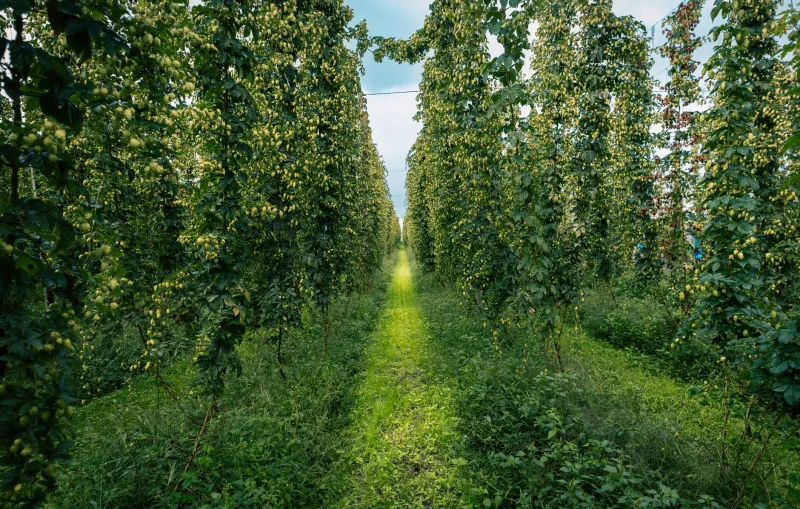
If you've ever cracked open a craft IPA and thought, this tastes different — not just hop-forward, but genuinely strange and specific in the best possible way — there's a decent chance a small, independent grower had something to do with it. Not a massive operation out of Yakima Valley or the Willamette. A farmer with maybe five acres, a lot of stubbornness, and a very particular vision for what American beer could taste like.
The hop industry in the United States is, to put it plainly, concentrated. The Pacific Northwest — primarily Washington State, Oregon, and Idaho — accounts for roughly 97 percent of domestic hop production. Within that geography, a handful of large agricultural conglomerates and cooperative-style operations control the lion's share of acreage, contracts, and proprietary variety development. For most of the 20th century, that arrangement worked fine. Beer was beer. Hops were hops.
But craft brewing changed the demand side of that equation entirely. And now a loose network of independent growers across the country — in Michigan, New York, the Carolinas, Vermont, even Texas — is quietly rewriting the supply side too.
Why the Big Players Don't Want You to Think About This
Here's a thing the major hop suppliers would prefer brewers not dwell on: a significant portion of the most exciting new hop varieties are developed by public research programs — at universities like Oregon State or through USDA breeding initiatives — and then licensed or released for open cultivation. The big players move fast to secure commercial rights and exclusive contracts. Small growers, by contrast, often seek out the varieties that fall through the cracks, or invest in heritage strains that the market has largely abandoned in favor of higher-yield commercial cultivars.
Take something like Cluster hops — one of the oldest American varieties, used in pre-Prohibition lagers and ales. It virtually disappeared from commercial production because it wasn't especially trendy or high-alpha. But small growers in the Northeast and Midwest have been quietly reviving it, and brewers who get their hands on it are discovering a complex, earthy character that modern varieties simply can't replicate.
That's not an accident. That's agriculture as a form of resistance.
Profiles in Stubborn
In central Michigan, a former high school science teacher named Dave Holstrom converted a portion of his family's property to hop cultivation about eight years ago. He started with Cascade — the obvious choice — but quickly pivoted toward experimental and heritage varieties after connecting with a small craft brewery about forty miles away that was desperate for something local and weird.
"The big suppliers can get you a contract for Citra or Mosaic all day long," Holstrom says. "But if you want something nobody else has, you have to go looking for it. And the only people who are actually growing that stuff are the small farms."
His current lineup includes a USDA experimental variety he won't fully identify (he calls it "the citrus weirdo"), a landrace hop sourced from a retired homebrewer in Ohio, and a low-alpha aroma variety that smells, improbably, like fresh cedar and black pepper. None of it would survive a cost-benefit analysis from a commercial supplier. All of it is sold out before harvest.
Out in the Hudson Valley of New York, a pair of former restaurant industry workers runs a certified organic hop yard that supplies about a dozen small breweries across the state. Their model is almost entirely relationship-based — no brokers, no middlemen, no futures contracts. Brewers visit the farm. They smell the bines. They taste the pellets. They decide what they want to build around.
"We're not competing with Yakima," one of them explains. "We're offering something Yakima literally cannot: a hop that grew in this soil, in this climate, with this water. That terroir is real. Brewers who care about place understand that immediately."
The Economics Are Brutal (And They're Doing It Anyway)
Let's not romanticize this too much. Growing hops on a small scale is genuinely difficult business. The infrastructure costs — trellising, harvesting equipment, pelletizing or drying facilities — are significant relative to the acreage small farms can cultivate. Yields are inconsistent. Weather is unforgiving. And unlike the big operations, independent growers don't have the purchasing leverage or the logistical networks to weather a bad season without real pain.
Contract pricing is another challenge. Small craft breweries often operate on razor-thin margins themselves, which means they can't always pay a premium that would make a small hop farm truly profitable. The relationship works when it's genuinely collaborative — when a brewer champions a grower's product, builds a beer around it, tells the story on the label — but those relationships take time to develop and aren't guaranteed.
Still, the growers doing this work seem to share a common conviction: that the alternative — ceding total control of American hop genetics and supply to a small number of large commercial interests — is worse than the financial risk they're taking on. Several of them mentioned, unprompted, their concern about what consolidation has already done to the flavor diversity of the American hop landscape.
"When the market decides that three varieties are what everyone wants, the genetic pool shrinks," says one North Carolina grower who recently began cultivating a nearly extinct Midwestern landrace variety. "And once those genetics are gone, they're gone. We're not just growing hops. We're preserving options."
What This Means for Your Pint
For beer drinkers, the practical upshot is this: the most genuinely distinctive beers you'll encounter over the next few years will increasingly trace their character back to small, independent hop farms rather than the standardized commodity supply chain. That's already happening at the margins — look for brewery tasting notes that name specific farms or regions, or small-batch releases tied to single-origin hop lots.
For brewers, particularly the small and independent ones, building relationships with regional hop growers isn't just a nice story for the taproom chalkboard. It's a genuine path to differentiation in a market that's getting more crowded every year.
And for the growers themselves? They're doing what farmers have always done when industrial agriculture tries to swallow everything whole. They're finding the edges. They're growing weird things. And they're betting that enough people still care about what's actually in the glass to make it worth the trouble.
So far, that bet seems to be paying off.